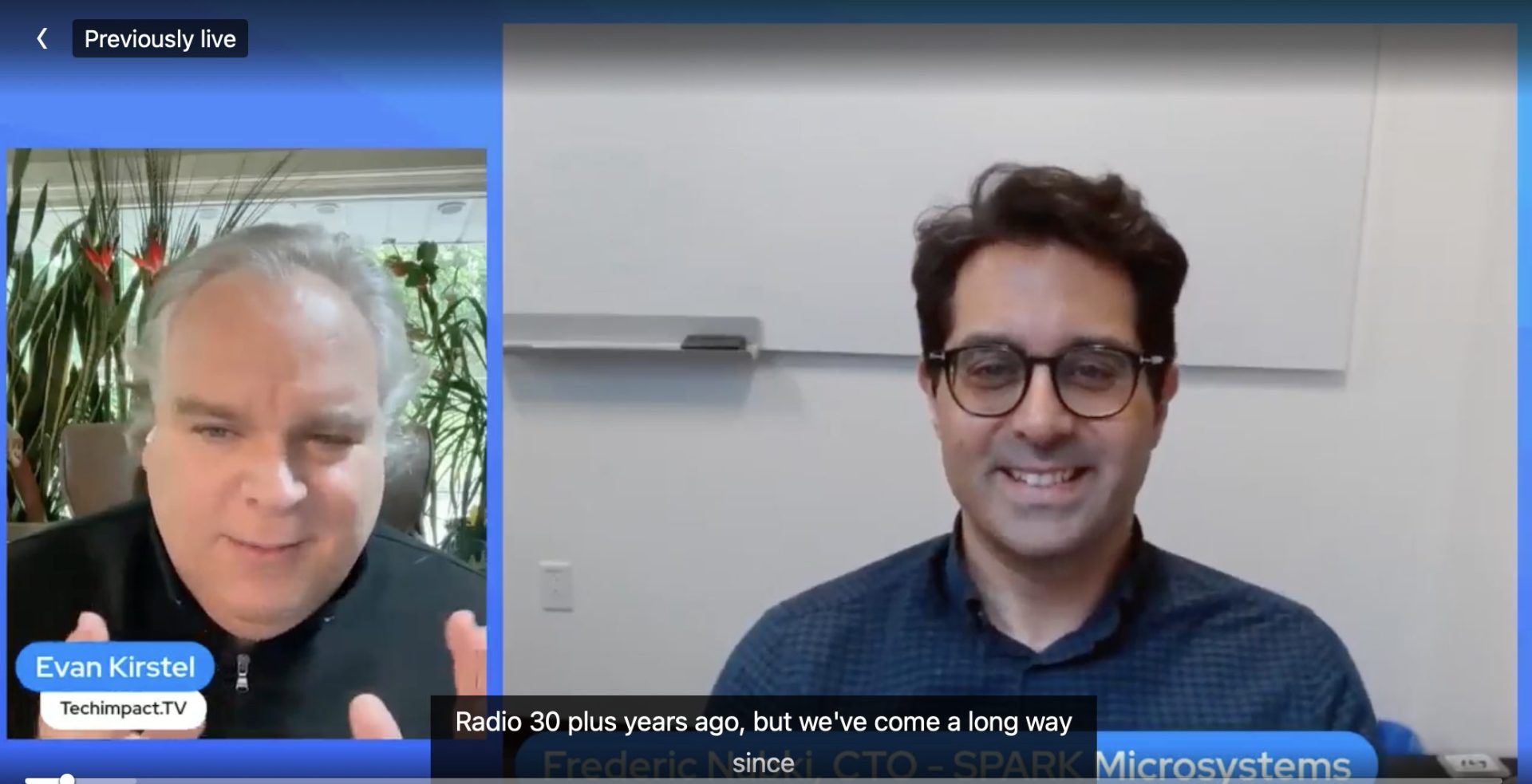
SPARK Microsystems Co-Founder and CTO Frederic Nabki recently joined Evan Kirstel for a conversation on one of the most important challenges in wireless product design: the “last meter” problem.
As connected devices become more intelligent, mobile, and responsive, wireless performance can no longer be measured only by range, throughput, or average latency. Applications in gaming, robotics, medical devices, wearables, and industrial IoT increasingly require wireless links that are ultra-low latency, robust in crowded RF environments, and power-efficient enough for battery-operated products.
In the discussion, Frederic explains how SPARK’s LE-UWB™ technology addresses these challenges with short-range wireless connectivity designed for deterministic performance, strong coexistence, and ultra-low power operation.
Listen to the full conversation to learn how SPARK is helping redefine what real-time wireless connectivity can make possible.
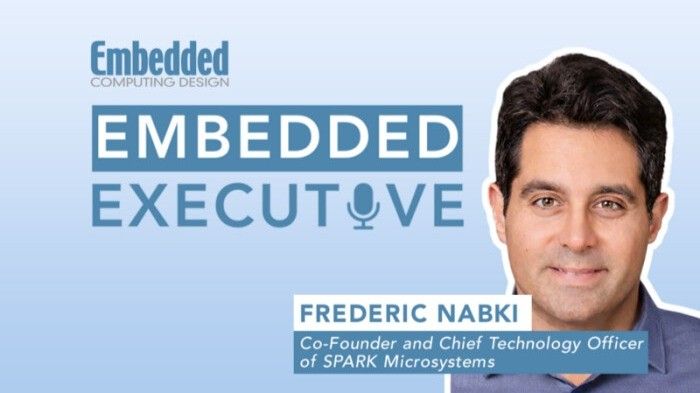
SPARK Microsystems was recently featured on the Embedded Executive podcast from Embedded Computing Design. In this episode, the discussion explores how SPARK’s LE-UWB™ wireless technology delivers ultra-low power consumption together with high bandwidth and ultra-low latency, enabling a new generation of Physical AI, gaming, audio, and IoT devices.
Operating across wide channels in the 6.2–9.5 GHz spectrum, LE-UWB enables short transmissions with reduced airtime exposure, helping maintain reliable performance even in dense RF environments. This approach allows designers to achieve responsive, wire-like wireless connectivity while minimizing power consumption.
Greetings, semiconductor pioneers
On the occasion of Silicon Catalyst’s 2025 Portfolio Company Update, which brought together semiconductor startups at the Computer History Museum, SPARK Microsystems was honored to share its perspective.
SPARK joined the Silicon Catalyst incubator program in 2017. Today, SPARK’s innovation is reverberating throughout the semiconductor industry and the diverse industries served by our valued customers in consumer electronics, industrial and IoT, medical devices and beyond.
SPARK specializes in short-range wireless transceivers leveraging ultra-wideband (UWB) connectivity. SPARK LE-UWB™ technology provides high data rate and very low latency wireless links at an ultra-low power profile, making it ideal for personal area networks (PANs) in the new era of AI and AR mobile connected devices.
Silicon Catalyst has been an important advocate for SPARK. SPARK is likewise a passionate advocate for our customers, partners, and peers striving to elevate the state of the art.
For semiconductor startups, the challenges can feel like the weight of the world on your shoulders. Semiconductors are the most sophisticated devices known to humankind. It’s not easy designing or manufacturing them. Navigating dynamic economic and supply chain variables isn’t easy either. Resilience, adaptability, steady direction and fiscal discipline will see you through.
When you succeed, you can enable transformational change.
SPARK LE-UWB technology is helping our customers transform the markets they lead in by helping them transcend the performance and power confines of legacy short-range wireless platforms like Bluetooth and Wi-Fi. Drawing on SPARK’s design expertise and commitment to excellence, our customers are achieving ‘world first’ breakthroughs.
Sonus faber, the prestigious Hi-Fi audio pioneers, sought a wireless link to pair their latest high-performance stereo speakers, free from the data rate, latency, and interference limitations of legacy wireless. They found SPARK LE-UWB and later introduced the world’s first consumer audio devices powered with UWB technology. Focal, the renowned French audio brand, brought its new SPARK LE-UWB-enabled speaker system to market in parallel.
More recently, SPARK announced collaborations with gaming peripheral experts Waizowl and ELECOM. Both are leading in their market with their respective announcements of the world’s first gaming mice equipped with SPARK LE-UWB as the sole wireless connectivity option.
SPARK’s recent solution collaboration with TokenMe has been successfully deployed at Denmark’s New Odense University Hospital, where it manages real-time tracking of tasks, assets, and personnel across a 250,000 square meter, multi-level construction site. SPARK LE-UWB enables precise positioning and reliability in real-time monitoring – essential for ensuring safety and efficiency in large-scale construction.
TokenMe’s success in this implementation is impressive in its own right. It’s the world’s first construction site deployment to harness UWB at ultra-low power. And it hints at even bigger innovations on the horizon.
SPARK LE-UWB’s ultra-low power profile is on a trajectory to help enable a new generation of battery-less wireless sensors that generate their own power from energy harvesting for greener IoT and infrastructure. Eliminating batteries and wires from future devices will liberate product designers and users in untold ways, with major environmental benefits.
Nick Kepler, COO, Silicon Catalyst, graciously provided this perspective: “SPARK anticipated the inherent limitations of legacy connectivity with data-intensive, power-hungry devices like AI glasses still on the horizon. Today, SPARK’s LE-UWB technology fits readily at scale in this domain and many others, from wirelessly connected healthcare and industrial devices to robotics, ranging applications and beyond.”
Guests of Silicon Catalyst – friends of SPARK – above all, you want your customers to succeed with your technology and thrive in a competitive marketplace. Their success is the best measure of your success, and both will benefit from close collaboration.
The SPARK Team wishes you great success.
Fares Mubarak, CEO
Competitive gaming is a latency-driven world. Every microsecond between a click and the action appearing onscreen can be the difference between a victory and a missed opportunity. 2025 has already been a big year for wireless mice, with major brands pushing polling rates and sensors to new heights. At SPARK Microsystems we applaud the innovation. But we also know that raw numbers on a specification sheet don’t always tell the full story, especially when congestion and limited 2.4 GHz radios start to bite.
The State of Wireless Gaming Mice Today
Mainstream gaming mice still use a 2.4 GHz radio link, it has been this way for 25 years. Nonetheless, flagship devices take major steps to reduce click latency. PC Gamer’s 2025 roundup even crowned the best 2.4 GHz wireless gaming mouse thanks to its smooth sensor and a dongle that supports an 8 kHz polling rate, though the feature is expensive and saps battery life. Independent measurements around the web put its average latency at roughly 0.29 ms, a good improvement over earlier 2.4 GHz mice, but the variance is broad: the histogram of click times can go up to more than 430 µs. Gamers would expect more consistency.
Innovation needs to plow ahead, and the wireless radio is a key piece of the puzzle to go beyond what is possible today. Bluetooth is not even a contender for serious play and 2.4 GHz radios are maxed out.
Enter SPARK low energy ultra wideband (LE-UWBTM) technology…
LE-UWB™: Already Challenging the Incumbents
Mice based on the LE-UWB™ are soon going to enter the market, but their performance is about to get even better. Current internal testing at 8 kHz shows a minimum latency around 60 µs, an average around 300 µs and a maximum around 406 µs.
Technologies of old like 2.4 GHz are maxing themselves out trying to keep up with wires, and they become highly unstable when exposed to heavy WiFi or USB3 activity (see here if you are curious). Accordingly, since we already solved the power consumption and interference problems, we chose to push LE-UWB™ to see how low our latency could go…
Over a LE-UWB™ link rather than 2.4 GHz, we can avoid congested spectrum, maintaining reliable connections and steady polling rate even when nearby WiFi networks are heavily loaded or common USB 3.x interference is near. SPARK’s own 8 kHz reference design demonstrates this advantage by delivering latencies as low as 0.2 ms and consuming 30 % less power than comparable 2.4 GHz devices. More on this later…
While click-to-screen latency is critical, the responsiveness of a gaming mouse also depends on how quickly the optical sensor can detect motion and relay it to the host. We recently measured sensor latency, from the optical sensor’s motion interrupt pin to the USB dongle, for the top 2.4 GHz gaming mouse and our LE-UWB™ reference mouse design, both running at an 8 kHz polling rate.
The results speak for themselves with regards to sensor wireless latency:
- 2.4 GHz: 356–618 µs (avg. 497 µs)
- LE-UWB™: 229–501 µs (avg. 363 µs)
That’s a sensor wireless latency advantage of ~130 µs for LE-UWB™. Our LE-UWB™-based mouse reference design transfers motion data to the PC faster than one of the most recent and highly regarded 2.4 GHz gaming mice on the market. That matters as much as click latency. With our upcoming reference design firmware update discussed next, this gap will widen even further…
Firmware update coming this week! Cutting latency by more than 100 µs.
As 2.4 GHz technology has clearly reached its performance ceiling for gaming, we decided to push further with LE-UWB™ and accelerate past it even further…
The first of two firmware updates is scheduled for release this week for all our customers and shaves off more than 100 µs of latency. This update will reduce latencies across the board. It achieves a minimum click latency of 60 µs, an average of 180 µs and a maximum of 286 µs. In other words, LE-UWB™ will deliver reaction times significantly faster than the average click on today’s top 2.4 GHz gaming mouse.
Because the UWB radio link is resistant to WiFi interference and USB3 noise, the polling rate stays locked at 8 kHz which is as important as raw latency. 2.4 GHz mice often drop packets or fall back to lower polling rates when nearby WiFi or 2.4 GHz traffic fills the band or USB3 noise is near, causing latency to spike into the multi-millisecond range.
Immunity to WiFi Interference: Where LE-UWB™ Stays Rock Solid
Speed is only half the story. Consistence under real-world conditions matters just as much. Our testing shows that today’s top 2.4 GHz gaming mouse can suffer dramatic performance hits in the presence of WiFi interference: polling rates can drop well below 8 kHz and latency can spike by a few milliseconds, a dramatic 10X+ degradation. This is a serious drawback in competitive play, where a single lag spike can decide the outcome.
In contrast, LE-UWB™ technology is inherently immune to such interference. In our measurements, latency and polling rate remained virtually unchanged with or without heavy WiFi activity nearby. This stability means gamers can enjoy wired-like performance without worrying about who else is streaming or gaming in the same space.
Looking Ahead to Later in 2025: An Unbridled Future
Our engineers are not stopping there. A second firmware release planned for later this year will unlock even more latency headroom in the LE-UWB™ mouse platform. Preliminary measurements indicate another 100 µs reduction in latency. Click latencies will be rock-solid at 60 µs for the minimum latency, 115 µs for the average latency, and an unprecedented 175 µs maximum latency. This is more than 2.4 times faster than the best 2.4 GHz radio can offer, while providing better power consumption and more link robustness. This consistency is only possible because LE-UWB™ is inherently built for robust low latency data transport.
Keep in mind that a USB wired gaming mouse running at an 8 kHz polling has very close latency metrics that are within ~30 µs of LE-UWB™ numbers. Combined with our energy-efficient hardware, LE-UWB™ will provide wired-like esports-grade responsiveness without compromising battery life and without having to contend with a wire. That is game changing innovation.
Conclusion: Beyond 2.4 GHz, Why LE-UWB™ Raises the Bar for Wireless Gaming Mice
For years, “top-tier” wireless gaming mice have lived on the crowded 2.4 GHz band. Even with smart frequency-hopping, they still contend with Wi-Fi/Bluetooth traffic and USB 3.x noise near receivers. Reviewers call out the trade-off clearly: push to 8,000 Hz polling and battery life plummets, from ~150 hours to ~22 on one flagship, so most users dial features back to stay powered.
LE-UWB™ is built for performance, without the trade-offs
SPARK’s LE-UWB™ mouse reference design avoids the 2.4 GHz dogfight entirely. It delivers:
- True low-latency clicks: sub-200 µs average click latency in current builds—comparable to the sensor itself and below what narrowband radios can reliably sustain.
- Headroom for high data rates: Ample bandwidth to move rich sensor data without choking under load.
- Real-world resiliency: Operation outside the congested 2.4 GHz band reduces sensitivity to Wi-Fi/Bluetooth collisions and common USB 3.x interference near dongles.
- Power efficiency designed-in: In SPARK testing, our LE-UWB™ mouse reference design shows 30%+ lower system power versus comparable 2.4 GHz designs at like-for-like performance.
Fair comparisons matter
The latest 2.4 GHz mice are impressive, and they deserve the praise. But when you normalize conditions (same polling rate, same DPI, same interference profile), the 2.4 GHz path still forces tough trade-offs in battery life and consistency under congestion. LE-UWB™ gives designers a wider performance envelope: ultra-low click latency, steady sensor throughput, and longer runtimes without sacrificing responsiveness.
What this unlocks for OEMs/ODMs
- Consistent input in busy venues (LAN parties, dense gaming environments).
- Feature headroom for 8K polling, higher DPI pipelines, haptics, and richer telemetry, without the usual “battery tax.”
- Future-proof roadmaps that extend beyond mice into keyboards, headsets, and multidevice ecosystems on a single LE-UWB™ stack.
The bottom line
If you’re designing the next generation of gaming peripherals, LE-UWB™ is the right path forward. It removes the hard 2.4 GHz constraints and enables new performance levels and features your users can feel, click after click.
Evaluate it yourself. Get hands-on with SPARK’s 8K LE-UWB™ Mouse Reference Design and talk to our team about integration options.
Note: All internal performance and power data reflect SPARK reference builds and controlled test conditions. Results will vary by implementation.
If it feels like you’ve been seeing SPARK Microsystems in the news a lot lately, there’s a good reason why.
In April, we launched the SR1120 UWB transceiver, a milestone for SPARK and the tech industry at large that was warmly received among customers, journalists, and market watchers alike. The news traveled quickly and widely. Among the headlines we enjoyed, Microwaves & RF perhaps summarized it best: “UWB Transceiver IC Blows Away Bluetooth on Wireless Data Throughput”
The innovation designed into the SR1120 speaks for itself, nevertheless we’re delighted when industry influencers speak up on our behalf!
With the arrival of SPARK’s SR1120, 40X better performance than Bluetooth is now achievable for short-range wireless data throughput – at approximately 25X lower power consumption than Bluetooth, and 60X lower latency. Compared to other UWB offerings in the market limited to ranging and positioning applications, the SR1120 delivers competing ranging capability at approximately 100X lower power consumption.
These are attention-grabbing numbers. But numbers don’t tell the full story.
THE NEXT CHAPTER
The SR1120 transceiver is SPARK’s second-generation product offering, an important achievement for any tech company, but particularly in the semiconductor market. Bringing a new chip – any chip – to market is among the most technically complex and resource-intensive undertakings in all of tech.
It’s perhaps difficult to convey the energy, passion and TLC that goes into a major product initiative like this. It was, on one hand, an opportunity for SPARK to celebrate all that we achieved with the first generation SR1020. But more importantly, it was an opportunity to celebrate where we go from here.
Surging customer demand for the SR1120 affirms the pressing need for UWB technology for high-performance connectivity and power and cost-efficient ranging/positioning. Where is UWB needed? Gaming, edge AI applications, audio, and a broad range of IoT use cases — including industrial systems, robotics, medical devices and far beyond. Anywhere Bluetooth and Wi-Fi struggle to keep up, there’s a clear need for SPARK UWB.
AI glasses (AR/VR devices) are a prime candidate for SPARK UWB and SPARK was delighted to connect with Semiconductor Engineering’s Liz Allan for a conversation on the topic. Be sure to check out her new feature story “AR/VR Glasses Taking Shape With New Chips” for a super insightful read about the technology alignments happening behind the scenes to propel this still-nascent technology into the mainstream.
There’s general agreement on what’s needed to get there – high data throughput, low latency and low power are critical aspects – and Allan’s story brings together perspective from some of the biggest players in the domain. SPARK was happy to lend our perspective. You can read all about it here.
SPARK DESIGN ACUMEN IN THE NEWS
Elsewhere in the media, SPARK was also happy to share our technical perspective on the state-of-the-art in UWB antenna design. As UWB technology goes mainstream, efficient antenna design is crucial for achieving high performance at low power. Be sure to read “A Fresh Look at RF Antenna Design with UWB Connectivity on the Rise” to learn more about how UWB technology differs from legacy platforms like Bluetooth and Wi-Fi, and why these differences matter for antenna design.
The article includes tips for creating more efficient antennas, managing signal patterns, and avoiding common pitfalls, as well as new and creative antenna design options for UWB, from compact chip designs to 3D-printed structures.
Switching gears, for a deep dive on UWB’s implications for consumer audio, head on over to Audioholics for an incredibly detailed view of the evolving UWB technology landscape, with an eye on Samsung and Apple’s recent exploits in UWB. SPARK UWB is featured within for our collaboration with Focal on its Diva Utopias speaker system.
In the story, editor and audio expert Wayde Robson speculates where UWB is headed in consumer audio, noting: “Focal’s new high-end powered speaker system, Diva Utopia is a rare practical application of UWB audio already in commercial use today…The SPARK Microsystems UWB chip that Focal/NAIM chose for the Diva Utopias creates a compelling use case for UWB audio.”
Friends of SPARK, we invite you to keep watching this space! There’re more headlines to be made, and more story to be told. The SR1120 begins an exciting new chapter.
On the heels of another amazing experience with customers and partners at CES 2025, the SPARK team was again reminded of the excitement and pent-up demand for short-range wireless connectivity that transcends the limitations of Bluetooth and Wi-Fi. People are waking up to the uncompromising performance and value that ultra-wideband (UWB) delivers above and beyond antiquated platforms, and the enthusiasm is palpable.
That’s because the vision for UWB has become reality. The innovative designers that spotted SPARK’s potential early on have harnessed it for leading brands like Sonus faber and Focal and others to be announced (stay tuned!). SPARK has been perfecting this technology for a decade and our customers are capitalizing on this success today, leveraging SPARK UWB connectivity as a competitive differentiator in competitive markets.
Change is in the air. SPARK UWB has entered the commercial mainstream. Consumers can buy and experience SPARK UWB-based products for themselves. And they are!
Indeed, as SPARK’s customers come to market with their trailblazing, SPARK-powered systems and devices, the SPARK team is reckoning with an entirely new audience: Our customers’ customers.
SPARK WELCOMES YOU!
As with the innovators that designed SPARK UWB into their products, their customers are likewise innovators for recognizing and embracing the SPARK UWB differentiator now available on store shelves.
It’s a special kind of consumer that ventures beyond the technology status quo to experience life at the vanguard. They’re the type of consumers who do their homework before taking the plunge into new technology, the same way we did when Bluetooth and Wi-Fi emerged in the 1900s (the standards for both were released in 1999).
Technology has come a long way since then, and with it came a flourishing internet which – thankfully! – makes it way easier for consumers to do our homework when we’re brand shopping.
Before we plunk down our hard-earned money, we demand to know what’s exciting and different about this product! How does the magic happen?
THIS IS HOW THE MAGIC HAPPENS
Longtime SPARK followers, blog readers and semi industry watchers at large are well versed in the technical ins and outs of SPARK’s value propositions in high-speed, high-volume short-range wireless data delivery that’s extremely power efficient and resistant to interference.
For SPARK’s new audience of customers’ customers, we’ve taken this opportunity to produce a series of video explainers that capture SPARK’s value propositions for audio and gaming, as well as presence detection for securing people, assets and equipment.
SPARK UWB is a revolution happening before our eyes. These videos help to visualize it.
Spend a couple minutes with these videos, and you’ll understand how SPARK UWB works and why it’s awesome. And as long as you’re here, there’s plenty of deeper-dive technical content available if you’d like to stay awhile and peruse our bookshelves. We invite you to linger as long as you like, and be sure to check back often for news and new content!
With no further ado – for our customers and their customers and anyone interested in the future of connectivity – we hope you enjoy our new video content available below and at our YouTube channel.
It’s that time of year, friends. A time to celebrate the new year, new customers, new breakthroughs, and the newest edition of the mammoth CES technology event, bringing the world’s leading innovators together again in Las Vegas.
CES brings new opportunities to discover new technologies with real transformative power. It’s the perfect place to unveil exciting new capabilities.
At CES 2025, SPARK will unveil some exciting capabilities of our own.
A NEW MARKET
To date, SPARK’s been known mainly for our prowess in audio, gaming and IoT applications, and CES attendees can look forward to seeing our very latest advancements in these domains. For the full itinerary of SPARK ultra-wideband (UWB) wireless connectivity demonstrations planned for CES 2025, refer here.
So what’s new with SPARK?
For the first time ever, SPARK Microsystems will provide public previews of our UWB technology for medical applications – medical implant devices, specifically. SPARK is at the outset of initiatives designed to bring the many advantages we deliver for audio, gaming and IoT onward to the medical domain where SPARK UWB shows clear potential to provide critically valuable benefits in healthcare.
To visualize the benefits SPARK is poised to bring to medical implants and mobile diagnostic, imaging and monitoring devices, consider the advantages SPARK UWB already provides today in key performance areas:
Data throughput – In medical applications, data throughput limitations can degrade the resolution of medical images and monitored vital signs. For mobile wireless medical devices historically limited by low throughput delivery, SPARK UWB can open these data pipelines.
How big an issue is wireless data transfer for tomorrow’s medical technologies? Neuralink recently issued a public challenge to solicit help to solve what’s been called a “seemingly impossible problem.” The root problem, as described by Canada’s CBC: “Turning brain signals into computer inputs means transmitting a lot of data very quickly – 200 times more brain data per second than [the Neuralink implant] can currently wirelessly transmit.”
That’s a lot of data! But no problem is impossible if you approach it the right way.
Latency – Medical monitoring devices – blood pressure monitors, cardiac rhythm monitors, continuous glucose monitors and many more – are designed to provide critical, real-time health data feedback. Immediate analysis and responsiveness enable improved medical outcomes, and low-latency data transmission is therefore a must.
SPARK UWB’s ultra-low latency outperforms legacy wireless platforms – Wi-Fi and Bluetooth – by a significant margin. This advantage can be a major asset for the next generation of wireless medical monitors and devices, both traditional and implantable.
Power efficiency – Medical device uptime is essential for administering care 24×7, posing an obvious challenge for mobile medical devices requiring periodic battery charges and changes that take them offline.
Here again, SPARK UWB outperforms legacy wireless platforms by a wide margin, with extremely low power consumption that can greatly extend the uptime for battery-operated medical devices. For implantable devices designed to be powered by external energy harvesters, SPARK’s extremely low power profile makes it an ideal complement between harvester and RF transceiver.
Interference Robustness – The congestion and signal interference that can plague narrowband 2.4 GHz WiFi and Bluetooth-based medical devices introduces reliability concerns in environments that can least afford them, whether mobile in the healthcare facility or used in the field.
Wireless medical devices operating at 2.4 GHz compete for signal paths in a tiny slice of frequency band that’s already overcrowded with a wide variety of Wi-Fi devices. SPARK UWB is unconfined by these narrowband interference limitations.
SEE YOU AT CES!
The performance profile enabled with SPARK UWB far surpasses the capabilities of Wi-Fi and Bluetooth for a wide range of wireless medical applications, and medical device makers have taken notice. We look forward to sharing updates with you as we go!
To preview the innovation that SPARK brings to medical devices – and audio, gaming, IoT and more! – be sure to visit with us at CES 2025. Click here for all the details.
SPARK UWB technology is breaking the performance barriers for wireless gaming and esports hardware. From polling rate to latency to interference, the advantages SPARK UWB enables for gaming mice have been well chronicled, and the broader ecosystem of UWB-enabled gaming hardware is likewise set to expand.
Customer conversations at CES2024, the Game Developers Conference (GDC), Computex and other forums throughout the year likewise affirm that SPARK’s innovation in UWB wireless is raising the bar for high-performance competitive gaming. Tier-one gaming hardware manufacturers have taken notice, and you’ll be hearing more about SPARK’s gaming and partner initiatives in the months ahead.
SPARK is on a mission to put wireless gaming mice and peripherals on par with the performance profiles delivered with wired mice and peripherals. And surprisingly (or not), many competitive gamers still prefer wired mice despite the obvious freedom-of-movement constraints imposed by the cord.
These gamers would cut this cord if they could because all gamers instinctively want to liberate their movements for unencumbered, fast-paced gaming. The recent arrival of 8,000 Hz (8K) wireless mice has done much to close the gap, leveling the playing field between wireless and wired mice in the performance profile.
But what about the power profile?
UWB FOR LONGER GAMEPLAY
Wired mice will always have the advantage when it comes to power consumption. The host computer acts as power supply, so there’s never a need to recharge a wired mouse. But you’re left to tangle with the mouse’s tail during gameplay, and it’s a drag!
If you could get comparable gaming performance from a wireless mouse – and at 8K, you can – how long are you willing to live with your mouse’s cord?
There’s an important nuance to understand as you consider this question: 8K performance is incrementally more power hungry than 4K, 2K and 1K, so 8K gameplay will naturally necessitate more frequent mouse recharges.
What’s needed is an across-the-board power efficiency boost for wireless gaming mice, from 1K all the way to 8K. SPARK UWB delivers this capability.
Testing data shows that SPARK UWB connectivity can enable over 30% lower power consumption than 2.4 GHz wireless gaming mice operating at 8K. This translates to at least 30% longer uptime for your mouse and fewer interruptions for recharging, for longer more immersive gameplay. And this power benefit scales from 8K all the way to 1K, and battery life gets increasingly pronounced as it does.
SET YOUR MOUSE FREE
The gaming industry and gamers themselves are evolving from wired to wireless gaming hardware peripherals. No one wants to be tied down with wires and cords in this day and age, and 8K wireless gaming mice have arrived to make cords obsolete.
It’s the power profile that enables us to break the next barrier, and SPARK is at the forefront of this advancement in gaming mice and esports peripherals.
SPARK UWB has broken the barriers to achieving high polling rate wirelessly at extreme low latency.
SPARK UWB has broken the barriers to wireless gameplay with extremely low RF signal interference.
SPARK UWB has broken the barrier to greater power efficiency at 8K, which is where the performance envelope needs to reside for wireless mice to finally achieve parity with their wired predecessors.
SPARK is bringing game-changing innovation to gaming hardware OEMs by breaking the longstanding performance and power barriers between wired and wireless gaming mice.
Watch this space to see which barrier we break next.
For more information about SPARK’s UWB technology for gaming, check out our Gaming Applications page.
SPARK Microsystems was thrilled to join our audio industry peers at AES Europe 2024 in Madrid recently, where we had opportunity to connect with some of the world’s leading audio manufacturers and innovators. Sponsored by the esteemed Audio Engineering Society, the event is an important steppingstone to the AES Show 2024 NY (Jacob Javits Convention Center, New York, October 8-10), the flagship AES event gathering 10,000+ audio professionals, enthusiasts, and exhibitors from around the world.
The event theme for AES Europe this year: “Echoes of the past inspire the sound of the future.” It’s a theme that couldn’t be more fitting.
These AES events throw a spotlight on the many ways our audio technologies – and our expectations for these technologies – have evolved in recent years. Legacy wireless platforms, Bluetooth chief among them, have served us well in the past and will continue to excel in some applications going forward.
High-quality audio isn’t one of them.
With the legacies of Bluetooth and power-hungry Wi-Fi echoing in the past, UWB is firmly positioned to deliver the wireless sound quality of the future.
It already is. SPARK Microsystems made history when the first ultra-wideband powered wireless speakers came to market last year via Sonus Faber’s Duetto speaker system (recognized by Forbes as “The Best Way To Listen Without Wires.”) At this year’s AES Europe event, SPARK was happy to share the perspective we’ve gleaned at the vanguard of UWB wireless audio. Gathered with industry peers and audience members, SPARK’s subject matter expert provided an overview of our UWB solutions for transporting low-latency, high-quality uncompressed audio, and shared our experience in getting real-world products to market.
THE WIRED PERFORMANCE STANDARD, ACHIEVED WIRELESSLY
Among SPARK’s recent audio achievements, we unveiled the Golion headset reference design, leveraging SPARK UWB Audio technology to deliver an unparalleled wireless audio experience.
SPARK’s groundbreaking UWB Audio offers exceptionally low latency of just 5ms to ensure perfect audio-video synchronization, complemented with the ability to deliver uncompressed audio data. With support for up to 24-bits resolution, the SPARK UWB Audio featured in the Golion headset reference design ensures that consumers can finally enjoy their music wirelessly to the highest possible quality standard.
Will consumers notice the difference for themselves?
Almost anyone who has listened to a pair of wired headphones since the turn of the century will tell you the answer is yes. Because anyone who’s listened to a pair of wired headphones in recent history was no doubt reminded of how much sound quality we sacrificed in order to accommodate wireless, mobile-friendly listening some two decades ago. The difference in sound quality between wired and Bluetooth wireless listening is still stark after all these years.
To this day, wired connectivity has remained the audio performance standard – Bluetooth hasn’t come close to matching it. It doesn’t take an audiophile or a roomful of audio experts to distinguish the superior audio quality that wired headphones deliver compared to literally any Bluetooth wireless headphone alternative in the market today.
SPARK’s Golion headset delivers a comparable audio quality experience to wired headphones – without the wires. UWB enables 10X more data throughput than BLE, and as a result, there’s no need to compress the audio signal for wireless delivery. Consumers will hear the difference. And they’ll enjoy virtually latency-free audio, another thing of the past that Bluetooth forced us to give up going wireless.
SHOW ME THE DATA
As mentioned above and elsewhere on the SPARK blog, consumer expectations are evolving – we expect more from our electronic device ‘experiences’. These products need to upgrade our enjoyment in order to justify the expense.
For those who’ve experienced the sound quality of the SPARK UWB-powered Sonus Faber Duetto wireless speakers or Golion wireless headsets, you’re probably already convinced of UWB’s advantages for delivering pristine, lossless audio.
The time has come to demonstrate these advantages with real-world data. It’s time to put SPARK UWB Audio technology to the test. Literally.
At AES Show 2024 NY, SPARK Microsystems looks forward to sharing the results of an exhaustive third-party expert analysis comparing SPARK UWB digital audio performance versus the performance delivered with a digital wire (S/PDIF or I2S).
What will the data show? Watch this space to find out! And be sure to visit SPARK at AES Show 2024 NY in October where we’ll be showcasing our latest advancements in UWB Audio technology. Don’t miss our workshop at 11 AM on Thursday, October 10, in Demo Room 3D04. Stay tuned for more details!
In the meantime, for more information about SPARK’s UWB Audio technology, check out our Audio Applications page.
It was a delight catching up with customers and gaming innovators behind the scenes at the recent Game Developers Conference. GDC is a great forum for developers and game makers to collaborate and cross-pollenate and it was a major success yet again this year. How successful? GDC hosted nearly 30,000 attendees for five full days. For SPARK, it afforded us another excellent opportunity to meet with some of gaming and esports’ foremost leaders.
Gaming has been a hot topic lately – it certainly was at CES! For SPARK and our customers in the gaming/XR domain, CES was occasion to celebrate successful initiatives with companies like XPG, iONE and others at the forefront of UWB adoption. At GDC, games and technologies previewed at CES made their exciting industry debuts within the developer community.
At events like CES and GDC, as well as throughout the gaming ecosystem, original design manufacturers (ODMs) play a crucial role. They are integral to the conversations that guide the evolution of the gaming market. Indeed, ODMs are essential for speeding the design, development, and production cycles for market brands of all sizes. Much of the value provided by ODMs comes from their ability to anticipate macro technology trends. They adopt these trends early to benefit their valued customers. This proactive approach accelerates customers’ time to market with the latest and greatest electronic devices.
A PRIME EXAMPLE
Primax Electronics (Taiwan) is a shining example of the successful ODM model, routinely posting billions (NT) in monthly revenue and growing to almost 10,000 employees with a global footprint across Asia, America, Europe and elsewhere. Forty years of stellar business achievement is no small feat. Moreover, it is all the more impressive that Primax continuously defers the spotlight to its many customers in the consumer electronics domain.
True to form, Primax was also among the first ODMs to immediately grasp the potential for SPARK UWB wireless connectivity, particularly in gaming applications. SPARK was honored to participate in Primax’s booth exhibition at CES 2024, where it showcased its next generation, UWB-based gaming hardware designs for enthusiastic crowds.
ODMs like Primax go out of their way to make onboarding advanced technologies like UWB smoother for customers. Likewise, SPARK is doing our part to help Primax and others get up to speed – quickly and cost effectively – with SPARK UWB gaming technology.
SPARK’s Gaming Reference Platform is tailor made for the task. Therefore, it has quickly enabled Primax and others to take advantage of SPARK’s own design acumen to help bring their UWB gaming innovations to life.
SPARK previously showcased our gaming reference designs and prototypes in a multi-part video series accessible over at SPARK’s YouTube channel. More recently, we demonstrated our Gaming Reference Platform at CES 2024 – you can see it in action here.
The CES demonstration features a gaming mouse that delivers polling rates of up to 8,000 samples per second. This mouse achieves a latency lower than 200 microseconds, which competing technologies simply can’t match. This is comparable to the optical sensor itself. In our SPARK UWB Gaming Mouse demonstration, you’ll witness the 8K Hz polling rate visualized in real time as the mouse changes position. This is made possible by the hardware reference platform.
SPARK UWB technology will be powering additional gaming peripherals as well – an ecosystem of gaming hardware devices. Furthermore, this will include extreme low latency gaming keyboards, mouse-keyboard combinations, and high-performance headsets with lossless audio quality. All these devices feature SPARK UWB’s extreme low power profile for longer uptime between charges.
ADAPT AND INNOVATE
Primax vertically integrates software, hardware, and R&D to manufacturing—a one-stop-shop for the world’s premier brands. This is a lot of responsibility. So it’s SPARK’s responsibility to simplify the adaptation of designs for the incoming wave of UWB-based devices. This makes it easier for Primax and others to integrate these advancements. These devices break the performance barriers of legacy Bluetooth and Wi-Fi connectivity.
Finally, SPARK offers robust, adaptable reference platforms and prototypes that gaming brands and ODMs can rely on. These tools are designed to elevate gaming to the next level. For more information or to request a SPARK UWB Gaming Reference Platform, contact us here.