In consumer device markets – particularly when it comes to apps like gaming, AR/VR (XR) and audio/multimedia – we hear a lot of talk about delivering improved “experiences.” Improved gaming experiences and music and entertainment experiences, for example. Is this just marketing hype?
Today’s electronic device vendors aren’t selling us products, they’re selling us on the idea that said products will appreciably enrich our lives. It’s not enough to offer better bit rates and bespoke specifications. These products need to upgrade our enjoyment in order to justify the expense.
Improving an “experience” sounds ambitious because it is! It requires careful attention to R&D and it requires carefully orchestrated interoperability across each and every device in our orbit so they may function – seamlessly – as one ecosystem. This approach takes a holistic, 360-degree view of the entertainment experience, and this is essential as the way we consume games, audio and multimedia entertainment transforms into the future.
EVOLVING TO XR
The trend toward ecosystem-level optimization will be increasingly accentuated as XR wearable technologies take hold. Today we’re inching toward full-function AR glasses and body-worn sensor connectivity with instantaneous responsiveness across devices, and it’s easy to imagine that this is where the future is headed.
Apple celebrated a major milestone recently with the introduction of its Vision Pro headset, and new milestones for Apple and others will surely follow. The market for XR is potentially massive and ripe for innovation. But it will be a journey.
For the time being, we’ll continue to enjoy games and multimedia mostly via traditional formats. And even here we can see how an holistic, ecosystem-centric view of the world can pay dividends.
END-TO-END QUALITY
Xtreme Performance Gear (XPG) is a prime example of how to be successful at ecosystem scale. A growing presence in gaming and esports, XPG is garnering design awards and accolades and turning heads at events like CES 2024, where SPARK was proud to co-exhibit our products.
Among SPARK’s customers, XPG was among the first to anticipate the value of UWB connectivity across an ecosystem of products. It recognized not only the performance advantages that SPARK UWB delivers at the device level but also the advantages achievable across all devices.
A new promotional video (below) from XPG illustrates this concept, highlighting the many connectivity and performance advantages that XPG’s new Mojo Wireless Ecosystem achieves, powered by SPARK UWB.
At the individual device level, the video shows how XPG MOJO Wireless gaming mice leveraging SPARK UWB can perform at polling rates up to 8,000 Hz, with discernibly smoother cursor tracking. Separately, the MOJO Wireless headset enables responsive head motion tracking to control gameplay camera/perspective positioning in real time, along with pristine audio quality.
At the ecosystem level, all of these devices – mouse, headset and keyboard – are wirelessly connected via a single dongle, with precise communication and ranging shared between them, and positional tracking for easy set-up and configuration.
With XPG’s MOJO Wireless Ecosystem, SPARK UWB short-range connectivity envelops the gamer and their devices in a wireless ‘bubble’ through which data can flow at high speed with extremely low latency and no signal degradation or compression. What’s more, device positioning is always in precise synchronization, and SPARK UWB connectivity ensures that MOJO Wireless Ecosystem devices are resilient from the narrowband interference that can plague Bluetooth and 2.4 GHz Wi-Fi devices.
XPG’s MOJO Wireless Ecosystem also features a common power profile across the devices – and it’s extremely low power! The MOJO system delivers almost 2X lower power consumption than its predecessor wireless system (XPG Alpha Wireless). At the ecosystem level, this helps to ensure that MOJO devices uniformly deliver long uptime between device charges for uninterrupted gameplay. The ecosystem enhances the overall experience.
END-TO-END PERFORMANCE
Instead of offering a patchwork of connectivity features among devices (in a narrowband frequency that’s highly congested), XPG’s MOJO Wireless Ecosystem delivers a unified, seamless, high-quality experience for gamers.
In gaming and esports as with a host of other apps, we’re approaching the outer limits of what’s possible with legacy short-range connectivity – the rise of XR will fully expose these gaps. SPARK UWB shows the way forward, ensuring high performance that’s beyond the reach of Bluetooth or 2.4 GHz Wi-Fi on the path to fully realized XR. This is the new quality benchmark that forward-looking companies can achieve when they embrace SPARK UWB connectivity across the portfolio – across the ecosystem – to deliver the improved experiences of tomorrow.
For more information about SPARK UWB’s advantages for gaming and XR applications, read on!
SPARK Microsystems is proudly based in Montreal, and we celebrate our roots here! More importantly, we take care to help cultivate these roots. Today, our local technology ecosystem is blossoming.
The semiconductor business opportunity in Canada continues to flourish, thanks in large part to our talented and enthusiastic peers and partners in the Canadian tech, academic and investor communities. We share great aspirations to make Canada’s tech sector among the world’s great technology hubs.
To help achieve this, the team at SPARK Microsystems thinks in global terms, for important reasons.
One, we believe UWB can be, should be and will be the short-range, mobile-optimized wireless platform of choice globally going forward – the next evolution beyond Bluetooth, and likewise a household name.
Ambitious? We believe in our technology. And we think big! It’s genuinely invigorating to wake up each day with a passion to perfect technology that can improve connectivity for everyone and help sustain the environment. Our global customers embrace our passion, and likewise we embrace theirs.
Second, experience shows us that technology and business acumen can derive from anywhere in the world, and SPARK endeavors to find it! SPARK is fortunate to draw talent and perspective from around the globe. Together we strategize for Canada’s success in semiconductor design and manufacturing, leveraging Canada’s strengths—a rich talent pool, clean energy, modern infrastructure and an expansive network of leadership and support throughout education and government. Working together we can catalyze the sector’s growth.
CANADA’S INAUGURAL SEMICONDUCTOR SUMMIT
We also guide our thinking globally when it comes to the semiconductor technology and supply chain ecosystem. This was one of the major themes underlining the recent inaugural meeting of Canada’s Semiconductor Council (CSC), which SPARK is proud to help lead. Our own Frederic Nabki serves as an advisory board member to help CSC with its mission to accelerate the growth and development of Canada’s semiconductor sector.
Gathering together key industry and government decision-makers from Canada and the US, Canada’s Semiconductor Summit helped establish priorities and define opportunities to enhance the competitiveness of Canada’s semiconductor sector in the context of tectonic shifts reshaping the global economy. The CSC acknowledges some important new realities. In their own words:
“As manufacturing reshores and semiconductors eclipse oil as the 21st century’s vital commodity, Canada is taking its place as a critical link in the North American semiconductor ecosystem.
The US Chips and Science Act’s $53 billion investment in American capacity is recalibrating market dynamics, positioning Canada’s Semiconductor sector for growth.”
The anticipated influx of system design talent and fabrication capacity into Canada will be great for the tech ecosystem and local economy (and for SPARK, it expands opportunities for our successful fabless semi business model). This is important stuff with local and global ramifications. The CSC is out in front of it, and SPARK is proud to support its mission.
IoT & THE ‘AI BOOM’
One of the central themes at Canada’s Semiconductor Summit focused on AI advancements transforming the technology ecosystem. This transformation impacts the semiconductor market and beyond, with major implications for IoT and smart infrastructure. IoT-optimized chips and devices will leverage efficient processing and low-latency connectivity. This combination aims to achieve tremendous growth and real-time responsiveness.
This synergy is essential for optimizing latency chains from end to end. In IoT applications, SPARK’s UWB technology integration ensures seamless, instantaneous communication. This is critical for monitoring sensors, smart devices, and autonomous systems.
Furthermore, SPARK UWB’s extreme low power profile is such that a SPARK-enabled IoT device can transmit sensor data and status updates wirelessly leveraging energy harvesting techniques only. Thus, no batteries or wires are required.
For short-range wireless IoT apps, SPARK UWB provides a high-throughput data pipe with sub-millisecond latency and minimal power consumption. Consequently, you can easily envision how pairing advanced technologies like AI-caliber processing with real-time, UWB wireless transmission could benefit the IoT in the future.
Canada’s unique AI opportunity was likewise highlighted in this recent, excellent, three-part article from EE Times focused on the need for cultivating Canada’s chip industry talent. The author’s perspective, and the industry perspective shared within, is in close alignment with CSC’s viewpoint: As the global semiconductor market evolves, Canada is uniquely poised to play a growing leadership role.
With a wealth of talent emerging through our universities and incubators, Canada is enhancing its educational focus. This focus includes mentorship, adapted curriculums, and university-industry collaboration. This approach allows Canada to be more responsive to rapidly evolving technology trends and market demands.
Through SPARK’s participation in the CSC, we hope to inspire continued investment in Canada’s greatest resource: its people. Per SPARK’s Fred Nabki, likewise featured in the EE Times three-part series (part 3):
“We have all the raw matter and brainpower we need to do as good a job as any country on this planet at becoming a powerhouse of semiconductors,” he said. “We have everything we need, but we need to be energized.”
The Canadian semiconductor opportunity is growing fast and the time to act is now. Consequently, in conjunction with Canada’s Semiconductor Council, SPARK is working hard to energize this effort.
For news and information about the CSC, visit canadassemiconductorcouncil.com
CES bills itself as “the most powerful tech event in the world” and it’s easy to see why.
CES 2024 was an incredibly successful event for SPARK Microsystems and the tech industry at large, energized by visitors from all over the world gathered in Las Vegas to glimpse into the future of groundbreaking consumer technologies. Entire product categories have revolutionized due to innovations previewed at earlier CES events, and CES 2024 attendees witnessed another revolution in the making.
SPARK UWB technology is transforming short-range wireless communication applications. Ultra-wideband connectivity is no longer an emerging technology. It has emerged.
The benefits delivered with SPARK UWB are real and they are impressive. And they’re being commercialized today, evidenced by the abundance of SPARK customers exhibiting their innovations at CES this year!
A NEW PERFORMANCE BENCHMARK FOR GAMING
In the gaming and esports domain, multiple hardware vendors were on hand at CES 2024 to showcase the next evolution in their product portfolios – innovations made possible by SPARK UWB. Featured among these vendors, XPG, Primax and iONE previewed a range of high-performance gaming mice, keyboards and gaming headsets coming soon for hardcore gamers hungry to take their gaming to the next level.
SPARK UWB breaks the performance barrier for wireless gaming peripherals by delivering polling rate performance up to 8,000 Hz, and 0.15 ms latency data transfer, both crucial for gaming performance. In the gaming arena, this ensures that players stay perfectly in sync with the on-screen action for faster responsiveness and superior gaming performance. Additionally, SPARK features an extremely low power profile to help ensure long uptime between device charges for uninterrupted gameplay.
XPG is building an entire ecosystem of UWB-connected gaming devices, leveraging SPARK UWB technology to deliver superior gameplay responsiveness from mouse to keyboard to headset – all of which deliver a new level of gaming performance that’s unachievable with legacy Bluetooth and proprietary 2.4 GHz wireless connectivity.
Gaming devices combining the freedom of wireless connectivity with the performance attributes of wired devices are a huge win for gamers seeking to sharpen their competitive edge. What’s more, they foretell a future for AR/VR device connectivity – from smart glasses to wearables – whereby users can be enveloped in a personal ‘bubble’ network delivering high-throughput, low latency connectivity for a truly immersive, real-time XR experience.
AMAZING AUDIO WITH UWB
Also at CES 2024, SPARK UWB was powering high-performance audio equipment, including – among others – the new Duetto active wireless speakers from Sonus Faber, the prestigious Italian manufacturer of handcrafted, high-end audio equipment. Visitors to SPARK’s CES suite got to hear the Duetto speakers for themselves, and the sound quality is second to none!
At the heart of the impeccably designed Duetto speaker system, you’ll find SPARK UWB technology enabling the high-performance, low latency wireless link between the two speakers. The system supports a range up to 8 meters for unfettered placement/positioning flexibility with no compromises in audio performance to ensure-wired like performance without the wires. And SPARK UWB technology sidesteps the interference and congestion issues inherent to 2.4 GHz Wi-Fi.
We were heartened to see UWB audio demonstrations elsewhere at CES, proof positive that the value UWB delivers is well understood by our peers in the tech industry. SPARK will continue to lead, and others will follow.
When it comes to audio, SPARK UWB transcends other UWB offerings in two important dimensions, the first of which is sound quality. In SPARK’s view, anything short of uncompressed, lossless audio is unacceptable for the next generation of wireless audio devices. SPARK UWB’s chief value proposition in wireless audio is that it vastly outperforms the audio quality of the legacy Bluetooth devices that consumers have relied on for the last 20+ years.
The second imperative – the holy grail for any wireless device, particularly the mobile kind! – is power efficiency. Long uptime between charges is crucially important, and SPARK UWB’s extremely low power consumption gives it a natural advantage over legacy Bluetooth and Wi-Fi.
In both of these areas – sound quality and power efficiency – CES demonstrations revealed that SPARK’s industry brethren in UWB tech still have some work to do. SPARK has set the UWB audio performance standard at 24 bits (stereo audio bit depths) and sample rates up to 96 kHz – with extremely low power drain.
For a closer look at SPARK’s CES 2024 demonstrations, head on over to our YouTube channel where you’ll find previews of demos spanning gaming mice, sensor fusion enablement, IoT connectivity and the Sonus Faber wireless speaker system.
Finally, it was a real delight to visit with visitors, customers and partners at CES 2024. It’s a great way to kick off the new year, and based on what we saw at CES, 2024 is going to be an exciting year!
Long time readers know that we like to celebrate innovation here at the SPARK Microsystems blog. When industry leaders come to market with bold new technology visions, it’s in our DNA to honor their achievements.
Today, we’d like to celebrate another innovator and leader, and in this case, they are also a SPARK customer and collaborator.
Sonus Faber, the prestigious Italian manufacturer of handcrafted speakers, headphones, and other high-end audio equipment, recently announced its Duetto active wireless speakers to much fanfare. At the heart of these impeccably designed speakers, you’ll find SPARK UWB technology.
The Duetto speaker system arrives with a wealth of audio source inputs, including optical, HDMI, and RCA/Phono. It is complemented with Wi-Fi and Bluetooth connectivity, enabling streaming from smartphones and other devices. Additionally, it supports the major streaming services and protocols natively.
Sonus Faber’s design team faced a major challenge, however, when it came to designing the communications link between the two independent speakers. They immediately ruled out wired connectivity for these sleek, strictly wireless speakers. Additionally, Bluetooth and 2.4 GHz Wi-Fi suffer from performance and interference issues.
Sonus Faber’s designers surmounted this seemingly impossible challenge with SPARK UWB connectivity. It’s the only short-range wireless solution in commercial production today capable of delivering high-quality, lossless audio with imperceptible latency. Additionally, it offers immunity to the interference issues that arise with the abundance of 2.4 GHz Wi-Fi connected home devices.
A MAJOR INDUSTRY MILESTONE
Sonus Faber’s Duetto system is groundbreaking on multiple levels. For one thing, it’s the company’s very first active stereo wireless loudspeaker system. It’s built upon 40 years of Sonus Faber’s high-fidelity audio engineering prowess.
What’s more, the new Duetto wireless speakers sound exquisite. Resonant, pristine sound that’s faithful to the audio source – faithful to what the musicians and artists we love intended it to sound like.
But don’t take our word for it, check out some of the headlines to emerge from the Duetto product launch! Here’s a headline that’s near and dear to SPARK’s heart, from Forbes: “Sonus Faber’s Duetto Active Wireless Speakers Are The Best Way To Listen Without Wires.”
The best way to listen without wires. This is SPARK’s calling card. SPARK UWB delivers the performance advantages of wired connectivity – high data throughput and ultra-low latency – wirelessly for the first time. And this is achieved at extremely low power.
Per Forbes senior contributing editor Mark Sparrow, “Active wireless speakers can sound a bit muddy, but the Duetto sound as good as any wired pair of speakers I’ve ever heard thanks to UWB.”
Thanks to SPARK UWB. That’s the other important thing that’s unique about Sonus Faber Duetto wireless speakers. This headline from Simon Cohen of Digital Trends says it all: “Sonus Faber’s Duetto are the first wireless speakers to use UWB.”
Per Simon, “Compared to Wi-Fi and Bluetooth, which are now household names, ultra-wideband (UWB) is an almost totally unknown technology. It’s understandable, as UWB is comparatively brand new. And yet, with its technical superiority over Wi-Fi and Bluetooth for some applications, the Duetto might be the first to employ it, but won’t be the last.”
In other words, history has been made. To our knowledge, Sonus Faber’s Duetto wireless speaker system is the first commercially available audio product to leverage UWB technology.
But it won’t be the last.
A NEW ERA IN AUDIO
We congratulate Sonus Faber for their technical achievement and vision. They have broken a major barrier in premium-quality, wireless audio delivery, and they’ve made history in the process.
SPARK is proud to play a part in the Duetto design, enabling the high-performance, low latency wireless link between the two Duetto speakers, while sidestepping the interference and congestion issues inherent to 2.4 GHz Wi-Fi. SPARK UWB enables audio bit depths up to 24 bits and sample rates up to 96 kHz wirelessly. There’s no compression or decompression needed or applied, and the raw audio data is transmitted with latency as low as 5 milliseconds to achieve pristine, high-quality lossless audio.
Readers interested in learning more about the recent Sonus Faber news can check out the news coverage and reviews at Forbes, Digital Trends, AudioXpress, TechRadar, What HiFi?, ecoustics and elsewhere around the web.
Watch this space, SPARK blog readers. History is being made here.
We’ve spent a lot of time articulating the many benefits of SPARK UWB technology here at this blog. It’s high time we showed you the technology in action!
We’re delighted to share a library of video demonstrations showcasing SPARK UWB technology for a wide range of industrial and consumer applications. Beginning with an Introduction to SPARK Ultra-Wideband (UWB) technology, this video series helps visualize the myriad advantages delivered with SPARK UWB short-range wireless connectivity: High data rates, ultra-low latency and precise positioning/ranging – all with extremely low power consumption.
What do we mean exactly when we talk about extreme low power? Check out this Battery-less, Wireless Sensor demonstration with our partner UBITO featuring a door/window-mounted sensor that wirelessly communicates status updates (position, temperature and time) using power harvested solely from the mechanical motion of the door or window opening and closing. Get a close-up view of the transmit and receive (T/R) units operating on only 75 nanojoules of energy – no batteries required.
For an up-close look at a next-generation Wireless IoT Sensor, we offer a demonstration showing a SPARK UWB-powered IoT sensor transmitting positioning, distance/range and light exposure data to a video monitor display. Every movement of the sensor is monitored and visualized in real time.
A Proximity Sensing demonstration highlights SPARK UWB’s low power proximity detection and sensing capabilities leveraging a SPARK reference platform that consumes a mere 50 microwatts of power. The dynamic proximity data is visualized in real time, and it’s a delight for anyone who’s ever envisioned next generation access and control apps – vehicle and e-bike keys, for example – whereby two devices can sense the distance between each other with precision accuracy.
You’ll also find a demonstration of SPARK UWB High Data Rate capabilities featuring two smartphones exchanging high quality, real-time video feeds over a high bandwidth UWB wireless link at a rate of 6 megabits per second. When was the last time you did this using Bluetooth? Trick question. You can’t. And compared to Wi-Fi, the UWB approach consumes a lot less power.
Featured among the videos is a gaming mouse platform delivering polling rates of up to 8,000 samples per second with the requisite latency that competing technologies simply can’t achieve – lower than 400 microseconds, which is comparable to the optical sensor itself. In this SPARK UWB Gaming Mouse demonstration, you see the 8K Hz polling rate visualized in real time as the mouse changes position – with the hardware reference design that makes it possible.
With our new Audio Headset demonstration, you’ll get a great look at our reference platform, but the audio quality advantage is best understood when you hear it for yourself! Amazing-sounding, lossless audio quality can now be achieved without wires, and you don’t have to be an audiophile to appreciate all that you’ve been missing up until now with legacy Bluetooth wireless audio.
The Audio Headset demo illustrates the way forward for achieving audio bit depths up to 24 bits and sample rates up to 96 kHz wirelessly. There’s no compression or decompression needed or applied, and the raw audio data is transmitted with latency as low as 5 milliseconds. SPARK UWB makes this possible.
Not only is this good news for music fans, it’s good news for musicians themselves! Check out the Wireless Musical Instruments demonstration, featuring a UWB-equipped electric guitar outputting wirelessly to an amplifier with no discernible latency lags or sound quality compromises. This makes it possible for musicians to practice and perform without physical cables encumbering their movement.
For innovative product designers eager to leverage the SPARK UWB advantage, we invite you to get started today! To this end, we’ve also featured a SPARK UWB Evaluation Kit demonstration video that showcases the design features and components included within, targeted for apps like high-quality audio and ranging. The Evaluation Kit also equips you to configure and customize wireless link properties – including payload, packet data rates and more – optimized for your specific target app.
Be sure to visit and follow our YouTube channel for the full library of SPARK video demonstrations, and plan ahead to visit with us at CES 2024 for a closer look at SPARK UWB in action via live demos and much more!
We’ve devoted a lot of digital ink here at the SPARK blog recently on the topic of gaming and esports hardware, particularly gaming mice. It’s a topic we’re passionate about, and our customers are super excited about it too!
In a relatively brief span of time, they’ve watched as SPARK UWB has leveled the playing field to make wireless gaming mice truly – finally! – performance competitive with wired mice at polling rates up to 8,000 Hz. And our customers have watched with great interest as gamers themselves begin to take heed of the important latency advantages that SPARK UWB delivers to complement and amplify the polling rate benefit.
Our customers’ enthusiasm for UWB innovation in gaming peripherals is infectious. For these vendors – as with their customers, the gamers – SPARK UWB is breaking stubborn barriers that have stymied high performance, competitive gaming for far too long.
Among the longstanding gripes that SPARK UWB has arrived to solve: The frustrating congestion and signal interference that continues to haunt narrowband Bluetooth and proprietary 2.4 GHz implementations.
HIGH TRAFFIC, HIGH FRUSTRATION
It’s not exactly a well-kept secret that gamers have had to contend with persistent interference issues when it comes to wireless mice, headsets, etc.
Wireless gaming devices operating at 2.4 GHz contend with significant RF congestion and interference in what is essentially a tiny slice of frequency band – one that’s already overcrowded with wide varieties of Wi-Fi devices and also non-Wi-Fi (802.11) devices including microwave ovens, security cameras, fluorescent lights, cordless phones – it’s a pretty long list.
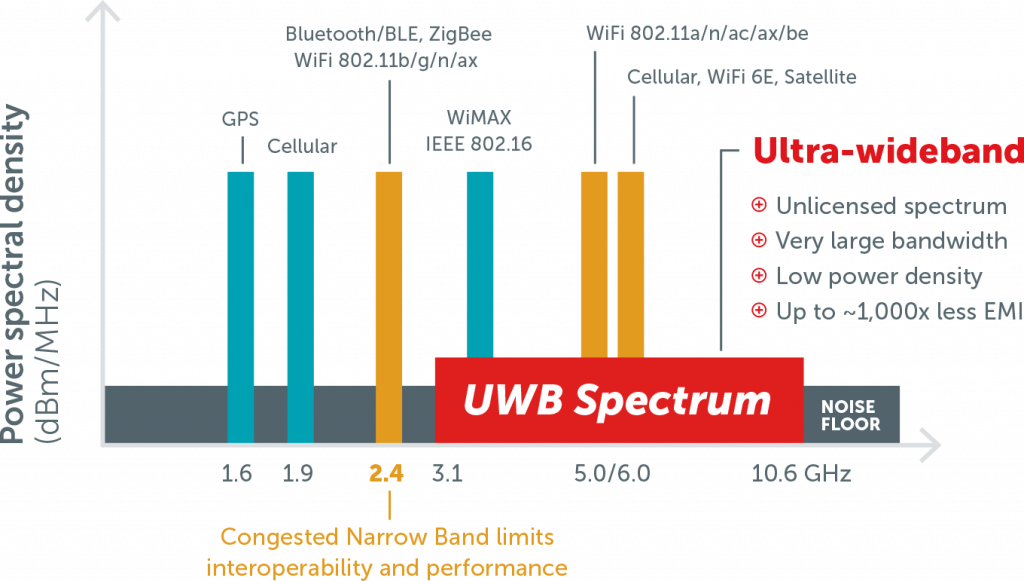
It’s easy to illustrate how intrusive Wi-Fi networks can be to surrounding Wi-Fi networks. Gamers and non-gamers alike – particularly city-dwellers – are quite used to picking up (strong!) Wi-Fi signals from our surrounding neighbors, and commercial Wi-Fi hotspots as well.
When a big game is on the line, can gamers trust that their short-range wireless connections won’t bend or break under these conditions? A lot of them don’t because they’ve learned the hard way that signal interference can cause sudden catastrophe.
Bluetooth, of course, also resides in this congested narrow band and struggles with many of the same issues when it comes to gaming peripheral connectivity. Inherent to Bluetooth is the assumption that there’s often several Bluetooth products trying to compete in the same spectrum – the data rate that Bluetooth can deliver is therefore limited by design.
We salute Bluetooth for being the first platform to free us from the constraints of wired gaming mice, and the freedom of movement that entails. But Bluetooth wasn’t intended to be a high-performance wireless gaming option. It’s prone to signal drops and connection loss, and the performance is merely adequate.
2.4 GHz delivers good performance with relatively good signal stability when compared to Bluetooth, but there’s major compromises elsewhere. 2.4 GHz also means much faster battery drain than Bluetooth – and potentially up to 10X faster power drain than what SPARK UWB enables.
SMALLER ‘BUBBLES’
In the future, we predict that for individual consumers – not just gamers, but everyone – the value we’ve put on widening our personal wireless connectivity radius will shift to emphasize the value of shortening these connections for many apps. For gamers, this helps to ensure limited interference from the get-go, among other important benefits. Privacy, for example, is a growing concern for device users/wearers, and short-range (10m), high-performance SPARK UWB helps answer these challenges in part by limiting the size of our personal ‘bubbles’.
Unconfined by narrowband limitations – the congestion, the interference – SPARK is putting the “short” back in short-range wireless for the apps that benefit the most. Gamers today and tomorrow (particularly as AR/VR takes hold) will benefit tremendously as our personal area networks (PANs) are supercharged for gaming and entertainment performance that only SPARK UWB can deliver.
For more information about SPARK’s innovations in gaming and esports devices, we invite you to visit our Applications page.
All eyes were on Apple for the recent launch of its much-anticipated Vision Pro headset, and Apple gave the media, consumers, competitors, industry watchers – everyone – a lot to talk about!
As with previous Apple device introductions (iPod, iPhone, iPad – all were historic in their own right), the new Vision Pro is an engineering marvel in multiple dimensions. The impossibly sophisticated technology that’s been carefully integrated within the Apple Vision Pro is seriously impressive. Its capabilities – too numerous to detail here – are a testament to Apple’s innovation in, what it calls, spatial computing.
WHAT IS SPATIAL COMPUTING?
In Apple’s own words: “Just as the Mac introduced us to personal computing, and iPhone introduced us to mobile computing, Apple Vision Pro introduces us to spatial computing. [The Apple Vision Pro] seamlessly blends digital content with the physical world…[it] lets users interact with digital content in a way that feels like it is physically present in their space.”
In practical terms, spatial computing enables an immersive computing and entertainment experience displayed on the screen in front of the users eyes, complemented with a spatial audio capability for positioning-aware sound (speech controls are also included). An endless array of App Store apps and content will become available in the months and years ahead to support richly interactive and seamlessly blended AR/MR experiences.
Interestingly, Apple never mentioned “VR” or “virtual reality” anywhere in its Vision Pro press release or news event – it’s understood that despite the VR-ish look and feel of the maiden Vision Pro, Apple has its sights carefully trained on the future of augmented reality (AR). Many already feel that AR smart glasses and headsets are the sweet spot for XR, and future editions of Apple’s Vision Pro will surely grow iteratively lighter, sleeker and less power hungry.
In the meantime, the design constraints Apple’s engineering team encountered in creating the Vision Pro were/are all too familiar to competing AR/VR device makers like Meta, Microsoft and others. Vision Pro uptime is currently limited to two hours per charge, and users must also wear a wired, discrete battery pack for mobile use.
Power efficiency remains the elusive holy grail for AR/VR device manufacturers, and technology innovations that preserve battery life will no doubt be warmly embraced for future products. At the short-range connectivity layer, advanced technologies like SPARK UWB hold the potential to help future wearable AR/VR devices dramatically reduce power consumption as well as battery size and weight.
The concept of spatial computing itself is likely to evolve as technologies like UWB are introduced into future generations of AR/VR glasses and headsets. The gesture controls currently onboard Apple’s Vision Pro are reliant on outward facing cameras that recognize users’ hand and finger motions – provided they’re in the camera’s line of sight. These cameras are both costly and inefficient in power usage.
Spatial computing, fully realized, could one day allow 360 degree, real time position sensing for tomorrow’s wearable sensors and controls. In this paradigm, the action will no longer be confined to what’s in front of us – the action can be all around us, moving unfettered as our limbs, hands and fingers naturally move. SPARK UWB, with its high data throughput, low latency, low power and positioning is very well suited to enable real time synchronization and control capabilities to make this vision a reality.
APPLE MOVES MARKETS
The first edition of Apple’s Vision Pro spatial computing devices is noteworthy both in terms of the capabilities enabled and the signal Apple is sending to the market with the device’s introduction. Apple is fully committed to AR, and Vison Pro “1.0” is just the beginning.
Apple had to start somewhere, and the Vision Pro is an amazing start. What does the future look like for the Vison Pro? In the words of one market watcher: “They know that the technology is going to get more compact, sleeker, and eventually they will be able to make a super sexy pair of glasses. I have no doubt. It’s going to be maybe two or three years away, maybe more than that, but they’ll get there.”
The SPARK Microsystems team salutes the Apple team for all that they’ve achieved with the Vision Pro – and all that can be achieved in AR, MR, XR innovation in the future.
For more information about SPARK’s innovations in AR/XR technology applications, we invite you to visit our Applications page.
The rise of esports-caliber wireless gaming mice has understandably focused gamers’ attention on the performance specs accompanying the latest wireless mouse unveilings. Hawk-eyed, hardcore gamers devour these specs in search of the narrowest of advantages to sharpen their competitive edge, and the specs accompanying the newest generation of wireless mice are eye-popping at first glance.
Where once wireless mice maxed out at 1,000 Hz polling rates, wireless gaming mice are coming to market now claiming polling rates performance from 4,000 Hz all the way up to 8,000 Hz, achieving parity with high-end wired gaming mice.
Polling rate comparisons have served us well when evaluating wireless vs wired gaming mice performance, providing gamers with a common and well understood reference point to gauge the latest gear. So much so that if you asked many esports gamers the spec that matters most for wireless mice, polling rate is usually the reflexive answer. This is reflected in media coverage as well.
But this is the wrong answer. Or rather, it doesn’t tell the whole story.
LATENCY MATTERS
When it comes to wireless gaming mice, expect to hear pro gamers and product reviewers alike talking more and more about latency going forward. To be sure, polling rate will remain an important differentiator among mice (all mice, not just wireless). But the new breed of wireless esports mice should also be assessed for their latency, because ultra-fast polling rates may provide little advantage if the performance gains are squandered in latency.
To quickly recap the key difference between polling rate and latency, polling rate denotes the number of times a mouse registers its position in the span of one second, measured in hertz. Higher polling rates equate to higher precision during motion tracking – a polling rate of 1,000 Hz equates to 1,000 positioning reports per second.
But if the lag to convey that data to the computer is too long – due to latency – the polling rate advantage can be significantly diminished. The gamer will show a tendency to keep moving the mouse beyond the desired position until the action on the screen catches up. The more the latency lag, the more the overshoot – and gameplay can suffer as a result. For hardcore gamers, this is unacceptable.
So why is latency suddenly top of mind for gamers and gaming media? Because until now, pro-caliber wireless gaming mice have been serviced by 2.4 GHz wireless connectivity, and the latency was never really scrutinized because there wasn’t a comparable, competing connectivity option to choose from among premium-quality gaming mice.
Until now.
SPARK UWB-based gaming mice are coming to market to compete with legacy 2.4 GHz-based wireless mice, and the latency advantages will be eye opening.
SPARK Microsystems’ UWB technology delivers high data rate for 4,000 Hz polling and higher, and low latency data transfer that is as good as, or better than the polling rate. In the case of 4,000 Hz, with SPARK UWB samples are taken every 0.25 ms and the data is transferred over the wireless link to the host computer within 0.25 ms or better (this includes button presses). With 2.4 GHz, this latency metric can lean closer to 0.5 ms – and serious gamers will notice the difference, in both the spec sheets and the gameplay.
2.4 GHz simply can’t compete with SPARK UWB’s latency advantages (among many other advantages). The game has changed for wireless esports mice. Polling rate is where the conversation starts. Latency is where it ends. And the side-by-side specs will be revealing when the first generation of SPARK UWB-based gaming mice arrive on shelves later this year. Get excited, gamers!
Traditional gaming and multimedia apps will one day be subsumed within the broader XR technology ecosystem, and the SPARK team has our eyes on the future as we innovate the BAN/PAN connectivity needed to enable exceptional XR experiences.
Wireless gaming mice exemplify the limitations of legacy short-range wireless connectivity today, but the door is open to a new generation of UWB-based gaming mice for tomorrow’s hardcore gamers on the path to full AR/VR immersion.
An entire category of consumer electronics devices – gaming mice – is quietly undergoing a major leap forward in capability, and it’s happening as we speak. And it’s exciting!
Since the dawn of esports, wired mice were considered indispensable for serious gamers seeking the utmost in performance, but times have changed – technology has changed – and wireless mice are coming to market soon that will completely close the performance gap between wired and wireless once and for all. And once this happens, just as we’ve seen in countless other categories of electronic devices, wired mice will largely be a thing of the past.
How did we arrive at this moment? What’s changed in the technology/connectivity landscape to make this possible?
BREAKING FROM THE PAST
Wireless gaming mice have slowly been making inroads into professional gaming competitions since at least 2017, when a League of Legends player became the first professional gamer to use a wireless mouse in competition. This was big news, since wireless gaming mice provide a major competitive advantage over wired mice: no physical tethers to slow or impede game play.
The emergence of pro-caliber wireless gaming mice was made possible by the underlying shift from Bluetooth to 2.4 GHz short-range wireless connectivity. Suddenly it was possible to boost polling rates up to 1,000 Hz, making wireless mice more competitive with their wired counterparts, which were capable of 2,000 Hz at the time.
Today, premium wired gaming mice are capable of 8000 Hz polling rates, and this is widely considered to be the performance benchmark that wireless mice must attain to be fully competitive. Innovative mouse vendors have tried to keep up by tweaking 2.4 GHz implementations to push polling rates as high as 4,000 Hz to deliver improved gameplay that approaches wired-caliber performance.
But 2.4 GHz – just like Bluetooth before it – has reached its performance ceiling. Even today, sustained 4,000 Hz performance is hard to deliver with 2.4 GHz (never mind the numerous interference challenges introduced at 2.4 GHz).
Going forward, 2.4 GHz offers no discernible upgrade path to 6,000 Hz or 8,000 Hz, and a new connectivity standard for wireless gaming mice is needed to achieve the next performance plateau.
UWB IS THE FUTURE
2.4 GHz was embraced by the gaming peripherals market because it was, excuse the pun, the only game in town at the time capable of outperforming Bluetooth in wireless peripherals. Today, wireless mice based on 2.4 GHz are currently lingering around the edges among ‘Best Mice for Esports’ product reviews, with PC Magazine recently acknowledging that “historically, most gamers would scoff at the idea of using a wireless mouse for competitive play.”
But that’s all changing. SPARK UWB has arrived to break the performance ceiling for wireless gaming mice, delivering performance that starts at 4,000 Hz polling rates, with a clear roadmap to 8,000 Hz.
For serious gamers seeking the agility of wireless gameplay, this transition can’t happen soon enough! And for the really serious gamers, the extreme polling rate isn’t even the most exciting aspect of the UWB value proposition. It’s the low latency that gets their attention, and we’ll go into more detail here in a later blog post.
It was perhaps inevitable that wired gaming mice would be among the last consumer electronic device categories to transition to wireless. Uncompromising performance is essential in esports – it’s the difference between victory and defeat.
Working collaboratively with our gaming customers, SPARK is innovating behind the scenes to bring the next generation of wireless gaming mice to market, with exciting announcements planned throughout 2023. Watch this space!
The news media has been buzzing about augmented reality (AR) and virtual reality (VR) technology on the heels of some impressive product unveilings. With AR/VR tech gaining early commercial momentum, technology leaders large and small are innovating and investing in AR/VR to speed the arrival of truly breakthrough XR and metaverse technologies.
So what does the state of the art look like today for AR and VR smart glasses and headsets? The recent news headlines have been revelatory.
Major shifts are underway in the design and economics of these devices, making them smaller, lighter and more affordable. The ability to enable long usage in between charges remains the elusive holy grail for mobile wireless AR and XR glasses (SPARK can help!), but great progress is being made here and elsewhere in AR and VR.
In this story from Gizmodo, HTC’s new Vive XR Elite wowed a product reviewer to praise the device’s sleek design. Per the author: “The form factor rules, and it’s probably what you should be most excited about. If it’s a symptom of other headsets to come, then VR’s most painful hurdle (the bulkiness) might be over.”
Meanwhile Sony’s new PlayStation VR2 headset is being praised for its tech, of course, but also its economic efficiencies that make it cost competitive in its device class. From a recent review: “[The PSVR2] provides nearly everything you can get in high-end PCVR kits for a substantially better price (potentially thousands less depending on the PC rig).”
Apple is of course widely rumored to be entering the AR/VR glasses domain this year, with Meta rumored to follow with the debut of its first AR glasses (not to be confused with Meta’s Quest headsets for VR apps). Tech companies from all corners are working overtime to claim their territory in the nascent AR glasses market. Each of these vendors brings a unique vision to AR/VR, and all will play a vital role in its realization.
HOW WILL WE OPERATE OUR AR SMART GLASSES?
As more AR/VR products are unveiled in the months ahead, we’ll have a much better sense of what the future holds. In the meantime, speculation continues to mount regarding the types of controls – physical buttons, voice controls, motion-based gesture controls, etc – that next-generation AR glasses and headsets will be equipped with.
What should we expect?
It’s perhaps easier to enumerate what we shouldn’t expect. When we envision the future of sleek, lightweight AR glasses perched on our noses as we navigate our daily lives in the physical world, we won’t be walking around with joysticks or “wands” in our hands (and in and out of our pockets) to maneuver and control the AR elements that are literally right in front of our eyes. This is just too cumbersome for AR apps. We need our hands free for other things!
Likewise, we don’t anticipate that the future of smart glasses involves users pawing at their faces every few moments to press a bunch of tiny buttons onboard their smart glasses frames. It’s not practical – it’s encumbering.
Voice activated controls will likely be a compelling option for some AR/VR applications in the future – but with some significant, persistent limitations. Voice controls can struggle in noisy environments, and user privacy is a non-starter when you’re speaking aloud to/through your AR glasses.
Surely in the future we won’t be fiddling with our smartphones to control our AR glasses and wearables – it defeats the purpose! For the time being, however, smartphones probably will play a central role in the AR user experience, with the phone doing the heavy lifting in terms of data processing and comms. This is probably an interim step toward smartphone functionality being fully (or mostly) absorbed within next generation AR glasses and headsets.
There is surely more innovation to come here, and media reports continue to mine for clues. Meta has demonstrated a “wristband controller” prototype device that reads electrical signals from users’ muscles and movements to navigate mixed reality experiences. Meanwhile over in Cupertino, media intrigue continues to ride high over recent Apple patent filings for “finger-mounted devices” – so called ‘Apple Rings’.
PREDICTIONS FOR AR SMART CONTROLS
So what can we expect for the future of AR device and smart glasses controls? Whether you subscribe to the metaverse concept or not, it’s understood that in augmented reality and virtuality reality – just like in actual reality – our hands and fingers are integral to our perception and awareness. Motion and gesture controls will be essential for interacting in mixed reality (MR), whether they’re mounted on our wrists, hands, fingers or elsewhere.
These devices will need to be lightweight, physically small and unobtrusive – with the tiniest of batteries, so extreme power efficiency is critical. And these devices must exchange huge volumes of sensor data wirelessly over the air, with no perceptible latency lag when synchronizing audio and video feeds, and ultra-precise spatial positioning/tracking of users’ hands, digits, etc.
If you can name a better connectivity solution than UWB, we’d like to hear about it. When it comes to AR glasses, Bluetooth, Wi-Fi and proprietary 2.4 GHz simply can’t compete across all of the requisite performance metrics: power efficiency, latency and data rate.
High throughput, ultra-low latency, interference resistant, extreme low power SPARK UWB technology is the ideal solution for the coming tidal wave of AR use cases requiring real-time responsiveness, positioning and controls at our fingertips. Stay tuned here at SPARK’s blog to read more about what UWB has in store for the future trajectory of AR, VR and XR!